

Electrical System Design Checklist for Commercial Buildings in Dubai
Commercial buildings in Dubai — office towers, retail centers, hotels, and mixed-use developments — depend on electrical systems that are reliable, code-compliant, and built to handle heavy daily loads without failure. Unlike residential projects, commercial electrical design has to account for higher power densities, complex load profiles, backup power requirements, and strict approval processes from authorities like Dubai Electricity and Water Authority (DEWA) and Dubai Civil Defence.
Whether you’re a developer, consultant, or facilities manager overseeing a new build, having a clear Electrical System Design Checklist keeps the project on track and reduces the risk of costly redesigns or failed inspections. This guide walks through the key items that checklist should cover, specifically for commercial buildings in Dubai.
Why a Structured Checklist Matters
Electrical design for a commercial building involves dozens of interdependent decisions — from transformer sizing to emergency lighting placement — made across multiple design stages. Missing even one item can lead to non-compliance with DEWA regulations, inadequate capacity for future tenant fit-outs, or safety issues that surface only after occupancy. A checklist approach ensures nothing falls through the cracks between concept design, detailed engineering, and final approval.
If your project needs the engineering itself rather than just a planning reference, our team’s Electrical System Design service covers the full scope from concept through DEWA submission.
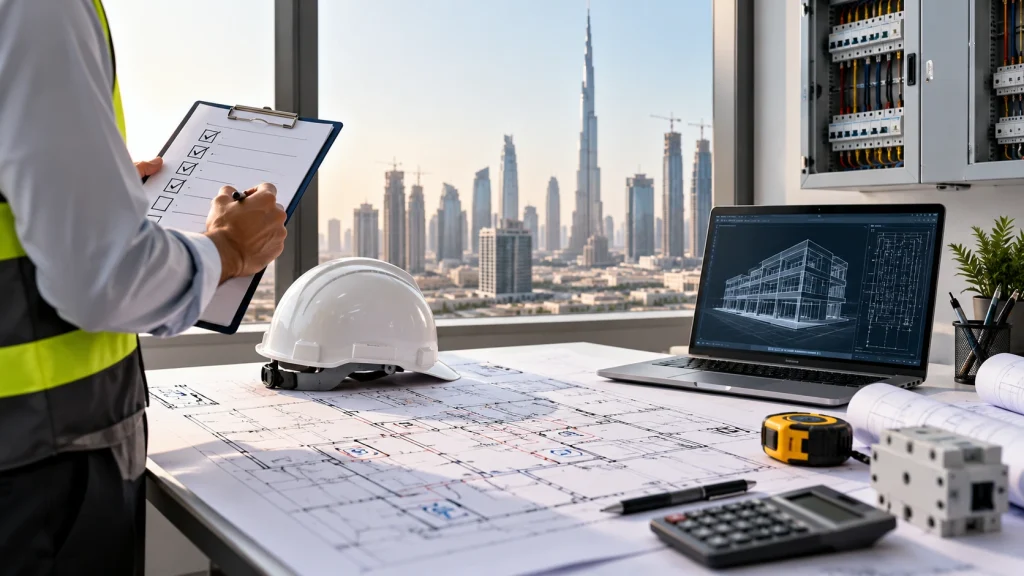
The Electrical System Design Checklist
1. Load Assessment and Demand Calculation
Before anything else, the design team needs an accurate picture of the building’s electrical demand. This includes:
- Connected load calculations for lighting, HVAC, lifts, and equipment
- Diversity and demand factors appropriate for the building type (office vs. retail vs. hospitality)
- Future expansion allowance, especially for shell-and-core buildings where tenant fit-out loads aren’t yet known
- Peak demand estimates to size incoming utility supply correctly
2. DEWA Approval Requirements
Dubai’s electrical infrastructure is tightly regulated, so early coordination with DEWA is essential. Checklist items here include:
- Confirming substation and transformer capacity availability in the area
- Submitting load applications and receiving DEWA’s approval for supply
- Coordinating meter room location and sizing per DEWA standards
- Aligning cable routing and substation layout with DEWA’s technical requirements
3. Distribution System Design
This covers how power moves from the incoming supply through the building:
- Main Distribution Board (MDB) and Sub-Distribution Board (SDB) sizing and locations
- Cable sizing and voltage drop calculations for all major feeders
- Busbar trunking systems for high-rise vertical distribution
- Power factor correction equipment to reduce losses and DEWA penalties
4. Backup Power and Standby Systems
Commercial buildings in Dubai — particularly hotels, hospitals, and mixed-use towers — typically require backup power for life-safety loads and, in many cases, business continuity:
- Standby generator sizing based on essential and life-safety loads
- Automatic transfer switch (ATS) designed for seamless failover
- Fuel storage and run-time requirements per civil defense rules
- UPS systems for critical IT, security, and communication loads
5. Lighting Design
Lighting is both a compliance item and an energy-efficiency consideration:
- General lighting layouts meeting lux level requirements per space type
- Emergency and escape lighting along evacuation routes, per civil defense codes
- Lighting control systems (occupancy sensors, daylight harvesting) to support Dubai’s green building requirements under Al Sa’fat or similar rating systems
- Exterior and facade lighting coordination, where applicable
6. Fire and Life Safety Electrical Coordination
Electrical design doesn’t operate in isolation from fire safety systems:
- Power supply coordination for fire pumps, smoke extraction fans, and pressurization systems
- Fire-rated cabling for life-safety circuits
- Emergency power backup for fire alarm and voice evacuation systems
- Coordination with the building’s FLS system design to ensure electrical loads for fire safety equipment are properly accounted for
7. Earthing and Lightning Protection
Given Dubai’s climate and building heights, this is a non-negotiable checklist item:
- Earthing system design meeting DEWA and IEC standards
- Lightning protection system design for high-rise structures
- Bonding of metallic building components to the earthing network
- Testing and certification of earth resistance values
8. Energy Efficiency and Green Building Compliance
Many commercial projects in Dubai must meet Al Sa’fat green building requirements or LEED-equivalent standards:
- Energy-efficient transformer and switchgear selection
- Metering and sub-metering for tenant billing and energy monitoring
- Renewable energy integration readiness (solar PV provisions on rooftops)
- Power quality management to minimize harmonics and losses
9. Documentation and As-Built Drawings
Before handover, the design team should confirm:
- Single-line diagram reflecting the final installed system
- Load schedules and panel schedules for facilities management
- DEWA completion certificates and inspection sign-offs
- Operation and maintenance manuals for switchgear, generators, and UPS systems
Common Mistakes to Avoid
- Underestimating future tenant loads in shell-and-core commercial buildings
- Delaying DEWA coordination until late in the design process, causing approval bottlenecks
- Overlooking power factor correction, leading to unexpected DEWA penalty charges
- Poor coordination between electrical and fire safety systems, creating gaps in emergency power supply
Final Thoughts
A thorough Electrical System Design Checklist keeps commercial projects in Dubai moving smoothly through design, approval, and construction — while reducing the risk of compliance issues or expensive rework after handover. From load calculations to DEWA coordination and fire safety integration, each item plays a role in delivering a system that’s safe, efficient, and built to last.
If you’re starting a new commercial project and need expert electrical design tailored to Dubai’s regulatory requirements, explore our Electrical System Design services for end-to-end support.
