

ELV System Explained: Meaning, Components & Uses
Walk into any modern tower in Dubai, a mall in Abu Dhabi, or a residential community in Sharjah, and you’re surrounded by ELV systems — even if you never notice them. From the CCTV camera watching the lobby to the access card reader at the office door, ELV technology quietly runs in the background of nearly every building in the UAE. Yet many property owners, developers, and even junior engineers still ask the same basic question: what exactly does ELV mean, and what does it cover?
This guide answers that question in plain language, then walks through the core components and real-world uses of ELV systems specifically within the UAE’s construction landscape.
What Does ELV Mean?
ELV stands for Extra Low Voltage. In electrical engineering terms, this refers to any circuit or system that operates at a voltage low enough to pose minimal risk of electric shock — generally below 50 volts AC or 120 volts DC, depending on the applicable standard. That’s the technical ELV system meaning in a single sentence: it’s a category of building technology that runs on safe, low-power electrical circuits rather than the higher-voltage mains power used for lighting or heavy equipment.
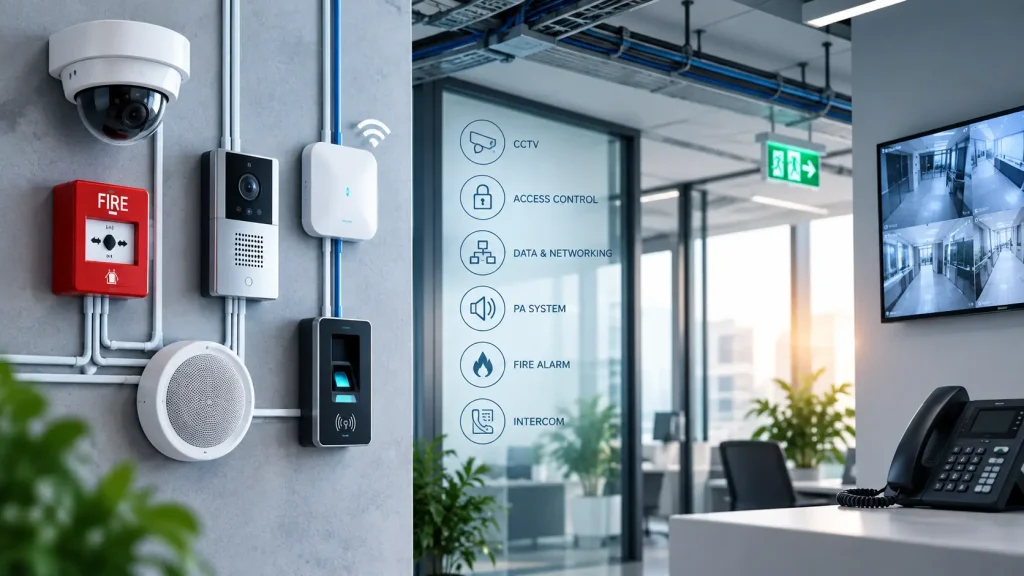
In practice, though, “ELV system” has come to mean something broader in the construction and MEP industry. It refers to the entire suite of low-voltage technology systems installed in a building — communication, security, entertainment, and automation systems that don’t fall under standard high-voltage electrical design. If you’re planning or reviewing one of these systems for a project, our detailed ELV system design and containment designing service page covers the engineering side in more depth.
Why ELV Systems Matter in UAE Construction
The UAE’s building codes, driven largely by Dubai Municipality, Dubai Civil Defence, and similar authorities across the Emirates, require ELV infrastructure to be planned and approved as part of the overall MEP design — not added as an afterthought. This is especially true for:
- High-rise residential and commercial towers
- Hotels and hospitality developments
- Shopping malls and mixed-use buildings
- Villas and gated residential communities
- Government and institutional buildings
Given the UAE’s strong focus on smart-building standards and security compliance, ELV design has become one of the most scrutinized parts of the approval process for new developments in Dubai and across the wider Emirates.
Core Components of an ELV System
While the exact scope varies by project, most ELV systems in UAE buildings include the following components:
1. CCTV and Video Surveillance Camera networks covering entrances, parking areas, common corridors, and perimeter zones — a near-universal requirement for commercial and residential towers in Dubai.
2. Access Control Systems Card readers, biometric scanners, and electronic locks that manage who can enter specific floors, offices, or restricted areas. These are heavily used in Dubai’s commercial towers and gated residential communities.
3. Public Address (PA) and Voice Evacuation Systems Speaker networks used for general announcements and, critically, for emergency evacuation instructions during a fire or safety event — often integrated directly with the fire alarm system.
4. Structured Cabling and Data Networks The backbone for internet, telephone, and internal networking infrastructure throughout the building.
5. Building Management System (BMS) Integration ELV systems frequently feed data into a central BMS, allowing facility teams to monitor security, HVAC, and safety systems from a single dashboard — a growing expectation in UAE smart buildings.
6. Intercom and Video Door Phone Systems Common in residential towers and villas across Dubai, allowing residents to screen visitors remotely.
7. Master Antenna Television (MATV) / IPTV Systems Centralized television distribution systems used in hotels, residential towers, and hospitality projects.
8. Home and Building Automation Lighting control, curtain automation, and integrated smart-home panels, increasingly standard in Dubai’s premium residential and villa developments.
Real-World Uses of ELV Systems in Dubai and the UAE
Hospitality: Dubai’s hotel sector relies heavily on ELV integration — from guest room automation and IPTV to centralized access control for staff and guest areas.
Commercial Towers: Office towers across Dubai’s business districts depend on ELV systems for tenant access control, CCTV monitoring, and structured cabling that supports modern IT infrastructure.
Residential Communities: Gated villa communities and apartment towers use ELV for intercoms, video door phones, and perimeter security — a strong selling point for developers marketing to security-conscious buyers.
Retail and Malls: Large retail developments use extensive CCTV networks, PA systems for both marketing announcements and emergency evacuations, and centralized BMS integration to manage energy use across large footprints.
Government and Institutional Buildings: These projects typically require the most stringent ELV specifications, particularly around access control and surveillance, in line with UAE federal and local security requirements.
ELV Design Considerations Specific to the UAE
Designing ELV systems for Dubai and the wider UAE comes with a few region-specific factors:
- Climate resilience: Equipment must handle high ambient temperatures and humidity, especially for outdoor cameras and access panels.
- Regulatory approval: ELV drawings typically need sign-off from civil defense and telecom authorities (such as du or Etisalat/e& for structured cabling) before installation.
- Smart city alignment: Many new developments are expected to align with Dubai’s smart city initiatives, pushing for greater automation and centralized monitoring.
- Scalability: With many UAE projects delivered in phases, ELV systems are often designed with future expansion in mind.
Final Thoughts
Understanding the elv system meaning is the first step toward appreciating just how much of a modern building’s safety, security, and convenience depends on this low-voltage backbone. In the UAE’s fast-moving construction sector — where developers compete on smart features, security standards, and guest or tenant experience — a well-designed ELV system isn’t optional; it’s foundational.
If you’re planning a project in Dubai or elsewhere in the UAE and need ELV infrastructure designed to meet local codes and future-proofed for smart-building integration, explore our ELV system design and containment designing services for a closer look at how we approach it.
